Wild Parents
WILD PARENTS
NATURE'S AMAZING CAREGIVERS
Animal parents do much more than bring babies into the world. They keep them safe, provide food, teach important skills and help them grow strong enough to live independently. Different species have different ways of caring for their young.
HOW ANIMALS NURTURE AND CARE FOR THEIR YOUNG
Six incredible animal families
🐘 ELEPHANTS — A FAMILY TEAM
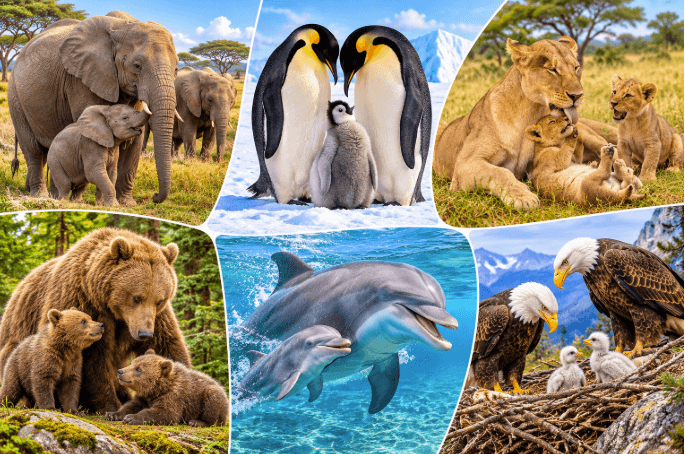
Elephant calves grow up surrounded by a close family herd. Mothers care for their calves, while other females may help protect, comfort and guide them. Young elephants learn by watching older members of the herd, including what to eat and how to respond to danger.
🐧 EMPEROR PENGUINS — SHARING THE JOB
Emperor penguin parents take turns caring for their chick. The male keeps the egg balanced on his feet and covered by a warm fold of skin while the female goes to sea to feed. After the chick hatches, both parents help provide food and warmth.
🦁 LIONS — THE PRIDE'S NURSERY
Lion cubs are raised within a pride. Lionesses usually do most of the day-to-day cub care and are also the pride's main hunters. Cubs begin by drinking their mother's milk and later start eating meat as they grow.
🐻 POLAR BEARS — WARMTH IN THE SNOW
A mother polar bear prepares a snow den where her tiny cubs can stay protected from the cold. She keeps them warm and feeds them with her milk. As they grow, the cubs follow her and gradually learn skills they will need in the Arctic.
🦧 ORANGUTANS — PATIENT TEACHERS
Young orangutans stay with their mothers for several years. They learn by watching and practising: what foods to eat, how to move through trees and how to build sleeping nests. This long period of learning helps them become independent.
🐬 DOLPHINS — GUIDANCE IN THE OCEAN
A newborn dolphin must reach the surface to breathe. Its mother helps guide it, and the calf stays close as it learns to swim, communicate and find food. Other dolphins may also support mothers and young calves.
Did you know?
Some animal parents share the work, while others raise their young mostly alone. There is no single way to be a good parent in the animal kingdom: each species has behaviours that help its babies survive in its own habitat.